

BEST PROFESSIONAL RESEARCH WRITING SERVICES IN UK! 40% OFF

Categories
Dissertation

500+ Dissertation Topics for 2026: The Ultimate Guide for UK Students

Choosing the right dissertation topics is one of the most important academic decisions you will make at university. Whether you are an undergraduate, Master’s or PhD student in the UK, selecting a strong dissertation topic can determine not only your final grade but also your confidence, research direction and future career pathway.

Many students struggle when choosing a dissertation topic. The pressure to be original, academically rigorous and aligned with UK university standards can feel overwhelming. Should you follow a trending subject? Focus on a research gap? Or refine one of your early dissertation ideas into a viable research project?

This guide has been carefully structured to go beyond generic lists of ideas for dissertation research. Instead of offering surface-level suggestions, we provide research-ready dissertation topics across major disciplines, aligned with British university marking criteria, feasibility standards and ethical considerations.

Written by UK academic consultants at Pro UK Writings, this resource is designed to reflect current university expectations, supervisor guidance practices and assessment frameworks across undergraduate, postgraduate and doctoral levels.

Need Assisting With any Kind of Writing?

Hire our experienced experts and elevate your grades!

How to Choose the Right Dissertation Topic (UK-Focused Guide)

Choosing the perfect dissertation topic is one of the most critical steps in your academic journey. Selecting a topic that aligns with your interests, academic level, and available resources can significantly affect the quality and impact of your dissertation. UK universities emphasise originality, research rigour, and relevance, making it essential to approach this stage thoughtfully.

What Makes a Dissertation Topic Strong?

A robust dissertation topic should not only spark your interest but also meet academic standards set by British institutions. Here are the key criteria to consider:

Originality: Your dissertation topic should offer a fresh perspective or address a gap in existing research. Avoid repeating studies that have already been extensively covered. Focus on areas where you can contribute new insights or challenge existing assumptions.

Researchability: Ensure your topic is researchable within the available time frame and resources. This involves defining a clear research question, developing a hypothesis, and identifying suitable methodologies—keywords: research gap, literature review, research question, hypothesis, methodology.

Ethical Approval Considerations: Many UK universities require ethical approval for research involving human participants. Choose a topic that allows you to comply with ethical guidelines, protecting participants’ rights while maintaining research integrity.

Clear Methodology Potential: Your topic should lend itself to a clear and feasible methodology. Whether you intend to use qualitative, quantitative, or mixed-methods research, the methods should align logically with your research objectives.

Access to UK-Based Data: Consider whether the data needed for your research is available within the UK context. Using local datasets ensures your findings are relevant and credible, which is particularly important for research that informs UK policy or practice.

By carefully assessing these aspects, you’ll ensure that your dissertation topic is academically sound, manageable, and impactful.

Common Mistakes UK Students Make When Selecting Dissertation Topics

Even experienced students can fall into common pitfalls when choosing dissertation topics. Avoid these mistakes to improve your chances of success:

  • Choosing topics that are too broad – overly general topics can make research unfocused and unmanageable.
  • No access to UK datasets – without reliable local data, your research may lack validity.
  • Lack of theoretical framework – topics without a clear theoretical basis risk superficial analysis.
  • Weak alignment with the marking rubric – always ensure your topic meets assessment criteria.
  • Ignoring supervisor feedback – your supervisor’s insights can refine your topic and prevent costly mistakes.

Being aware of these pitfalls ensures you select a dissertation topic that is feasible, academically rigorous, and aligned with UK university standards.

Undergraduate vs Master’s vs PhD Dissertation Topics

Dissertation expectations differ significantly across academic levels. Understanding these differences can help you choose an appropriate topic:

Level 6 (Bachelor’s)

  • Focus on developing analytical and research skills
  • Topics can be narrower and less complex
  • Emphasis on understanding and applying existing theory

Level 7 (Master’s)

  • Requires deeper critical evaluation
  • Originality is more important; topics should fill a gap in existing research
  • Use of advanced research methodologies and analytical tools

Doctoral Research (PhD)

  • Focus on significant, original contributions to knowledge
  • Topics are highly specialised and often cross-disciplinary
  • Requires comprehensive methodology, robust data collection, and theoretical innovation

By aligning your topic with the expectations of your academic level, you enhance both feasibility and impact, increasing the likelihood of achieving top marks.

Trending Dissertation Topics in the UK for 2026

Staying up-to-date with emerging trends ensures your dissertation is relevant and impactful. Below are carefully curated UK-focused dissertation topics for each trending area in 2026.

Technology & Artificial Intelligence Dissertation Topics

  1. The role of AI in improving patient outcomes in the NHS
  2. AI-driven diagnostic tools: opportunities and limitations in UK healthcare
  3. Data privacy challenges under UK GDPR for AI in medical research
  4. The impact of AI on administrative efficiency in NHS hospitals
  5. EdTech adoption in British schools: benefits, challenges, and outcomes
  6. Machine learning applications in the UK public sector service delivery
  7. Automation and workforce displacement in UK industries
  8. Ethical considerations for AI-driven decision-making in UK organisations
  9. AI in predictive policing: effectiveness and societal implications in Britain
  10. Chatbots in UK customer service: adoption, satisfaction, and ROI
  11. AI in UK financial services: fraud detection and compliance
  12. Natural language processing in UK legal document analysis
  13. The adoption of AI in UK transport infrastructure planning
  14. Virtual reality and AI in UK higher education teaching methods
  15. The impact of AI on mental health app effectiveness in the UK
  16. Blockchain and AI integration in the UK supply chain management
  17. AI and energy optimisation in UK smart cities
  18. The future of autonomous vehicles on UK roads
  19. AI in personalised learning platforms in UK schools
  20. Ethical AI frameworks: compliance challenges for UK businesses
  21. AI-enabled predictive analytics for NHS resource allocation
  22. Machine learning in UK climate modelling and environmental planning
  23. AI applications in UK retail: consumer behaviour and sales forecasting
  24. The impact of AI on cybersecurity strategies in UK companies
  25. AI for social care planning: improving outcomes in UK elderly care
  26. Adoption barriers for AI technology in UK SMEs
  27. Human-AI collaboration in UK workplaces: productivity and acceptance
  28. Bias in AI algorithms and its implications for UK public policy
  29. AI-driven mental health interventions: feasibility in UK schools
  30. Regulatory challenges for AI innovation under UK law

Sustainability & Climate Policy Dissertation Topics

  1. Evaluating the UK’s net zero carbon policies: successes and gaps
  2. Renewable energy adoption in UK households: policy vs practice
  3. Corporate ESG reporting in British companies: effectiveness and transparency
  4. UK environmental law: enforcement and compliance challenges
  5. The impact of climate change policies on UK SMEs
  6. Public perception of net zero initiatives in the UK
  7. Renewable energy transition: the role of government incentives in Britain
  8. Sustainable transport policies in UK urban areas
  9. Green finance and investment opportunities in the UK
  10. Assessing the effectiveness of carbon taxation in the UK
  11. Circular economy initiatives in UK manufacturing: challenges and benefits
  12. Climate adaptation strategies for UK coastal communities
  13. Environmental education programmes in British schools
  14. The role of UK local councils in promoting sustainability
  15. Green building practices and energy efficiency in UK housing
  16. UK corporate strategies for reducing environmental impact
  17. Evaluating renewable energy projects in Scotland, Wales, and Northern Ireland
  18. Public-private partnerships in UK environmental conservation
  19. The role of technology in achieving net zero in the UK industry
  20. Sustainable agriculture policies and their impact on UK food security
  21. The effectiveness of UK government subsidies for renewable energy
  22. Climate litigation in the UK: outcomes and precedents
  23. Behavioural change programmes for sustainable lifestyles in Britain
  24. Offshore wind energy development in the UK: opportunities and risks
  25. Urban green spaces and biodiversity conservation in UK cities
  26. Policy frameworks for reducing industrial emissions in the UK
  27. Environmental monitoring and data use in UK climate policy
  28. Corporate social responsibility and environmental stewardship in UK firms
  29. The economic implications of transitioning to a low-carbon UK economy
  30. Comparative study of UK vs EU climate policy effectiveness

Mental Health & Wellbeing Dissertation Topics

  1. Evaluating NHS mental health service delivery: effectiveness and accessibility
  2. Remote work and employee mental health in UK organisations
  3. Post-pandemic mental health challenges among UK university students
  4. Workplace stress interventions in UK public sector employees
  5. The role of mindfulness programmes in improving student wellbeing in UK universities
  6. Access to mental health services in rural vs urban areas of the UK
  7. Evaluating digital mental health apps: adoption and efficacy in the UK
  8. Mental health support for NHS frontline workers during COVID-19
  9. Social stigma and barriers to mental health care in Britain
  10. Workplace bullying and its psychological impact in UK organisations
  11. Community-based mental health initiatives in the UK
  12. The impact of flexible working hours on UK employee wellbeing
  13. Mental health awareness campaigns in British schools
  14. Evaluating counselling services in UK higher education institutions
  15. The role of family support in mental health outcomes in the UK
  16. Assessing the effectiveness of Cognitive Behavioural Therapy in NHS clinics
  17. Post-pandemic PTSD among healthcare professionals in the UK
  18. Stress management training and productivity in UK workplaces
  19. Workplace mental health policies in UK SMEs: compliance and outcomes
  20. Youth mental health programmes in UK secondary schools
  21. Mindfulness-based interventions for stress reduction in UK employees
  22. The impact of social media usage on adolescent mental health in Britain
  23. Evaluating peer support groups for mental health recovery in the UK
  24. NHS mental health funding: implications for service quality and coverage
  25. The role of physical activity in promoting mental well-being in UK adults
  26. Comparing teletherapy vs face-to-face counselling in the UK
  27. The effect of workplace diversity initiatives on employee mental health in Britain
  28. Mental health outcomes for veterans using UK government support programmes
  29. Employee assistance programmes and their impact on UK workforce wellbeing
  30. Evaluating the integration of mental health education in UK school curricula

Subject-Wise Dissertation Topics (Comprehensive Coverage)

Business & Management Dissertation Topics

Business & Management Dissertation Topics

Leadership

  1. The impact of transformational leadership on employee performance in UK SMEs
  2. Ethical leadership practices and organisational culture in British corporations
  3. Leadership styles and crisis management in UK public sector organisations
  4. Emotional intelligence and decision-making effectiveness among UK managers
  5. Gender diversity in leadership roles: UK corporate case studies
  6. Servant leadership and employee engagement in UK tech start-ups
  7. Strategic leadership in UK multinational companies during Brexit
  8. Leadership development programmes in UK higher education institutions
  9. Comparative study of leadership styles across UK and EU businesses
  10. The role of inclusive leadership in promoting workplace equality in Britain

Human Resources

  1. The impact of flexible working policies on employee retention in UK companies
  2. HR strategies for managing remote teams across multiple UK regions
  3. Talent acquisition challenges in UK STEM industries
  4. Employee engagement strategies and productivity in UK organisations
  5. Diversity and inclusion initiatives in British workplaces
  6. The effect of HR analytics on decision-making in UK corporations
  7. Managing workplace conflict: HR perspectives from UK SMEs
  8. Employee well-being programmes and organisational performance in the UK
  9. Compensation and benefits strategies in the UK public vs private sectors
  10. The role of HR in implementing UK government employment legislation

Supply Chain

  1. Brexit’s impact on UK supply chain management in the retail sector
  2. Sustainable supply chain practices in British manufacturing
  3. Risk management strategies for UK logistics and distribution networks
  4. Digitalisation and AI adoption in UK supply chains
  5. The effect of global disruptions on UK import-export operations
  6. Supply chain resilience in the UK food industry
  7. Lean supply chain practices and efficiency in British SMEs
  8. Ethical sourcing and corporate social responsibility in UK supply chains
  9. Impact of e-commerce growth on UK logistics strategies
  10. Blockchain applications for traceability in the UK supply chain management

Entrepreneurship

  1. Barriers to female entrepreneurship in the UK
  2. The impact of government grants on UK start-up success
  3. Social entrepreneurship and community development in Britain
  4. Entrepreneurial innovation in UK tech hubs
  5. Risk-taking behaviour and venture success in UK SMEs
  6. The influence of networking on business growth in the UK
  7. Family business succession planning in British enterprises
  8. Entrepreneurial education and its effectiveness in UK universities
  9. Crowdfunding trends and their impact on UK start-ups
  10. Comparative analysis of entrepreneurial ecosystems in London vs regional UK cities

Digital Transformation

  1. Digital transformation strategies in UK retail businesses
  2. AI adoption in UK financial services: challenges and outcomes
  3. Cloud computing integration in UK public sector organisations
  4. Cybersecurity risks and mitigation in UK digital enterprises
  5. The role of digital tools in enhancing UK employee productivity
  6. E-commerce adoption in UK small businesses post-Brexit
  7. Big data analytics and decision-making in UK firms
  8. Digital transformation and customer experience in UK banking
  9. Industry 4.0 implementation challenges in British manufacturing
  10. Evaluating the ROI of digital innovation projects in UK SMEs

Finance & Accounting Dissertation Topics

Finance & Accounting Dissertation Topics

IFRS

  1. The adoption of IFRS 16 in UK lease accounting: challenges and impacts
  2. IFRS compliance and financial reporting quality in British corporations
  3. The effects of IFRS 9 on the UK banking sector risk management
  4. Accounting for intangible assets under IFRS: UK company case studies
  5. IFRS implementation and audit quality in UK-listed companies
  6. Transition from UK GAAP to IFRS: organisational challenges
  7. IFRS standards and transparency in UK corporate reporting
  8. Comparative analysis of IFRS adoption in UK vs EU companies
  9. IFRS 17 insurance contracts and financial reporting in the UK
  10. The role of IFRS in facilitating cross-border investments in Britain

UK Taxation

  1. Corporate tax compliance challenges in UK SMEs
  2. The impact of UK VAT reforms on small businesses
  3. Tax avoidance strategies and ethical implications in British corporations
  4. Brexit and its influence on UK corporate taxation
  5. Comparative study of UK and EU corporate tax policies
  6. The role of tax incentives in promoting green investments in the UK
  7. Individual tax planning and behavioural finance in Britain
  8. The effect of digital taxation policies on UK multinational companies
  9. UK inheritance tax policy and wealth distribution
  10. Evaluating HMRC enforcement and compliance strategies

Corporate Governance

  1. Corporate governance mechanisms and financial performance in UK firms
  2. Board diversity and decision-making effectiveness in British companies
  3. Shareholder activism and corporate governance reforms in the UK
  4. Corporate governance failures and lessons from UK scandals
  5. Risk management practices in UK corporate boards
  6. Ethical frameworks for UK company directors
  7. Governance challenges in family-owned businesses in Britain
  8. Executive compensation and shareholder value in UK corporations
  9. Corporate governance codes and compliance in the UK
  10. Sustainability reporting and governance integration in British firms

ESG Finance

  1. ESG investing trends in the UK financial markets
  2. Corporate social responsibility and its impact on UK stock performance
  3. Green bonds and sustainable finance in Britain
  4. ESG disclosure practices in UK public companies
  5. ESG risk assessment and investment decision-making in UK banks
  6. The influence of ESG ratings on UK corporate reputation
  7. Climate-related financial risk reporting in UK financial institutions
  8. Socially responsible investment strategies in British pension funds
  9. ESG policy adoption and shareholder engagement in UK firms
  10. Regulatory challenges for ESG compliance in UK finance

Marketing Dissertation Ideas

Consumer Behaviour in the UK

  1. The effect of online reviews on UK consumer purchasing behaviour
  2. Cultural influences on buying behaviour in British millennials
  3. Impulse buying patterns in UK e-commerce
  4. Consumer loyalty programmes and retention in UK retail
  5. Ethical consumption trends among UK consumers
  6. Brand perception and decision-making in UK fashion industry
  7. The role of social media in shaping UK consumer preferences
  8. Green marketing and eco-conscious behaviour in Britain
  9. Comparative analysis of urban vs rural UK consumer behaviour
  10. Consumer response to personalised marketing in British e-commerce

Digital Marketing Analytics

  1. Measuring ROI of digital marketing campaigns in UK SMEs
  2. Big data analytics for predicting UK consumer trends
  3. Social media engagement metrics and brand performance in Britain
  4. Email marketing effectiveness in UK retail sector
  5. Analytics-driven content marketing strategies for UK brands
  6. Website user experience optimisation for UK audiences
  7. Digital influencer analytics and campaign performance in the UK
  8. The impact of AI-driven marketing tools on UK e-commerce
  9. Marketing automation and customer retention in British businesses
  10. Data privacy regulations and analytics compliance in UK marketing

Influencer Regulation

  1. Impact of UK Advertising Standards Authority (ASA) guidelines on influencer marketing
  2. Consumer trust and influencer transparency in the UK
  3. Ethical challenges in UK influencer campaigns
  4. Social media influencers and brand credibility in Britain
  5. Regulatory compliance for sponsored content in UK markets
  6. Micro vs macro influencers: engagement patterns in UK industries
  7. The role of disclosure in UK influencer marketing effectiveness
  8. Legal liabilities for UK influencers promoting products
  9. Influencer marketing trends in UK fashion and lifestyle sectors
  10. Comparative analysis of UK vs global influencer regulations

Brand Ethics

  1. Ethical branding and consumer perception in the UK
  2. Corporate social responsibility campaigns and UK brand loyalty
  3. Greenwashing in UK companies: consumer reactions
  4. Transparency in brand communication in British businesses
  5. Ethical marketing practices in UK retail sector
  6. Socially responsible branding and millennial engagement in the UK
  7. Ethical supply chain communication and UK brand reputation
  8. Crisis management and brand ethics in British corporations
  9. The impact of ethical certifications on UK consumer trust
  10. Comparative study of UK vs European brand ethics standards

Law Dissertation Topics (UK-Specific)

Law Dissertation Topics

Human Rights Act

  1. The impact of the Human Rights Act 1998 on UK policing policies
  2. Human rights compliance in UK immigration enforcement
  3. The influence of Human Rights Act rulings on UK healthcare law
  4. Balancing national security and individual rights under UK law
  5. The role of the Human Rights Act in UK family law cases
  6. Judicial interpretation of freedom of expression in the UK
  7. Human rights considerations in UK criminal sentencing
  8. The Human Rights Act and disability discrimination in Britain
  9. Comparative analysis of UK Human Rights Act vs European Convention
  10. Access to justice under the Human Rights Act in UK courts

Data Protection

  1. The impact of UK GDPR on corporate data handling practices
  2. Data breaches and legal accountability in UK businesses
  3. Ethical challenges of AI data collection under UK law
  4. Data protection compliance in UK healthcare organisations
  5. Consumer privacy rights and enforcement in Britain
  6. Cross-border data transfer challenges post-Brexit
  7. The role of the ICO in regulating UK data protection standards
  8. Social media platforms and user data protection in the UK
  9. Big data analytics and GDPR compliance in British enterprises
  10. Legal implications of data retention policies in UK public sector

Corporate Liability

  1. Corporate liability for environmental breaches in the UK
  2. Directors’ legal duties and corporate misconduct in British companies
  3. Health and safety compliance: corporate liability in the UK workplace
  4. UK corporate liability in financial fraud and accounting scandals
  5. Corporate manslaughter law: effectiveness in UK industries
  6. Liability of multinational corporations operating in Britain
  7. Product liability and consumer protection under UK law
  8. Comparative study of UK vs EU corporate liability regulations
  9. Cybersecurity breaches and corporate responsibility in UK firms
  10. Corporate governance and legal risk management in British companies

Employment Law

  1. The impact of UK employment law reforms on gig economy workers
  2. Workplace discrimination claims under UK law: trends and challenges
  3. The role of employment tribunals in resolving UK workplace disputes
  4. Parental leave policies and legal compliance in the UK
  5. Flexible working rights and employer obligations in Britain
  6. Employment contracts and termination law in UK SMEs
  7. Health and safety legislation enforcement in UK workplaces
  8. Trade unions and collective bargaining in contemporary UK law
  9. Employee privacy and monitoring under UK employment law
  10. Brexit-related changes to employment rights in Britain

Criminal Justice Reform

  1. The effectiveness of rehabilitation programmes in UK prisons
  2. Sentencing guidelines and their impact on UK criminal justice outcomes
  3. Police accountability and reform in British law enforcement
  4. Youth justice policies and recidivism rates in the UK
  5. Impact of counter-terrorism legislation on civil liberties in Britain
  6. Drug policy reform and decriminalisation in the UK
  7. Forensic evidence and legal standards in UK criminal trials
  8. Community policing strategies and public safety in Britain
  9. The role of restorative justice in UK criminal law
  10. Comparative study of UK criminal justice reforms vs EU countries

Education Dissertation Topics

Higher Education

  1. The impact of tuition fees on access to UK higher education
  2. Online learning platforms and student engagement in British universities
  3. Graduate employability programmes and career outcomes in the UK
  4. International student integration and cultural diversity in UK universities
  5. The role of academic advising in improving student retention in Britain
  6. University rankings and their influence on institutional policies in the UK
  7. Leadership development programmes for UK higher education staff
  8. The effectiveness of mental health support services in UK universities
  9. Alumni networks and their impact on current UK students’ opportunities
  10. Sustainability initiatives on UK campuses and student environmental awareness

Primary & Secondary

  1. The effect of class size on student achievement in UK schools
  2. The role of school leadership in enhancing teacher performance
  3. Literacy intervention programmes in British primary schools
  4. Anti-bullying policies and outcomes in UK secondary schools
  5. The impact of school facilities on student learning in the UK
  6. Parental involvement and academic outcomes in UK schools
  7. Digital learning tools and technology integration in British classrooms
  8. Physical education programmes and student wellbeing in UK schools
  9. Special educational needs (SEN) inclusion strategies in UK primary schools
  10. After-school programmes and their effect on student achievement in Britain

Educational Leadership

  1. Transformational leadership and school culture in UK education
  2. Ethical leadership practices in British schools
  3. Data-driven decision-making and its impact on UK school performance
  4. Leadership challenges in rural vs urban UK schools
  5. Managing change during curriculum reforms in British schools
  6. Promoting teacher professional development through school leadership
  7. Leadership strategies for inclusive education in the UK
  8. School leaders and mental health support for students
  9. Community engagement and leadership effectiveness in UK schools
  10. Preparing aspiring educators for leadership roles in British institution

SEND (Special Educational Needs & Disabilities)

  1. Inclusion strategies for students with SEND in UK mainstream schools
  2. Teacher training programmes for SEND support in Britain
  3. The impact of personalised learning plans on SEND student outcomes
  4. Parental involvement in SEND education in the UK
  5. Policy effectiveness of the Children and Families Act 2014 in SEND
  6. Assistive technology and SEND learning outcomes in British schools
  7. Collaboration between schools and external agencies for SEND support
  8. Assessing the effectiveness of multi-sensory teaching methods in the UK
  9. SEND provision and social inclusion in British primary schools
  10. Early intervention programmes for children with SEND in the UK

Curriculum Reform

  1. The impact of STEM curriculum integration in UK schools
  2. Culturally responsive teaching strategies and curriculum design in Britain
  3. Assessment reforms and student performance in UK secondary schools
  4. Digital literacy integration in UK primary education
  5. Curriculum adaptations for diverse learners in British schools
  6. Citizenship education and promoting democratic values in the UK
  7. Environmental education and sustainability in UK curricula
  8. Curriculum innovations for critical thinking development in British schools
  9. Health and wellbeing education in UK schools
  10. Comparative analysis of UK national curriculum vs devolved nations’ curricula

Psychology Dissertation Topics
Psychology Dissertation Topics

CBT (Cognitive Behavioural Therapy)

  1. Effectiveness of CBT in treating anxiety disorders in UK adults
  2. CBT applications for depression management in British adolescents
  3. Online CBT programmes and patient engagement in the UK
  4. Comparing group vs individual CBT outcomes in Britain
  5. CBT effectiveness for workplace stress management in UK employees
  6. CBT for PTSD among UK veterans: challenges and results
  7. Adaptation of CBT for neurodiverse populations in Britain
  8. CBT and comorbid conditions: treatment strategies in UK clinics
  9. Long-term effectiveness of CBT interventions in British mental health services
  10. CBT vs pharmacological interventions for mild depression in the UK

Neurodiversity

  1. Supporting neurodiverse learners in UK schools
  2. Workplace inclusion strategies for neurodiverse employees in Britain
  3. ADHD interventions and academic performance in UK children
  4. Autism spectrum disorder support systems in British education
  5. Neurodiversity awareness training in UK workplaces
  6. Cognitive assessments for neurodiverse individuals in Britain
  7. Mental health support for neurodiverse adolescents in the UK
  8. Policy implications for neurodiverse inclusion in British schools
  9. Social perception of neurodiversity in UK society
  10. Assistive technologies for neurodiverse students in the UK

Workplace Psychology

  1. The impact of remote working on UK employee mental health
  2. Job satisfaction and productivity in British organisations
  3. Leadership style and employee engagement in UK workplaces
  4. Workplace stress and burnout prevention in the UK
  5. Organisational culture and team performance in British companies
  6. Employee motivation strategies in UK SMEs
  7. Conflict resolution interventions and workplace outcomes in Britain
  8. Work-life balance policies and staff retention in UK businesses
  9. Psychological safety and innovation in UK organisations
  10. Effectiveness of mindfulness programmes in British workplaces

Youth Mental Health

  1. Post-pandemic mental health trends in UK adolescents
  2. School-based interventions for anxiety and depression in Britain
  3. Digital platforms and their impact on youth mental wellbeing in the UK
  4. Bullying and mental health outcomes among UK teenagers
  5. Youth access to NHS mental health services: challenges and improvements
  6. Social media usage and psychological outcomes in UK adolescents
  7. Peer support programmes for youth mental health in Britain
  8. Early intervention strategies for mental health issues in UK schools
  9. Family involvement and adolescent mental wellbeing in the UK
  10. Youth resilience programmes and mental health outcomes in Britain

Sociology Dissertation Topics

Sociology Dissertation Topics

Immigration

  1. The social integration of immigrants in UK urban communities
  2. Brexit’s impact on EU migrant labour in Britain
  3. Refugee resettlement programmes and community cohesion in the UK
  4. Immigration policies and educational outcomes for migrant children
  5. Cultural adaptation of migrants in British workplaces
  6. Public perceptions of immigration and social policy in the UK
  7. The role of local councils in supporting immigrant communities in Britain
  8. Economic contribution of immigrants to UK regional development
  9. Second-generation migrant identity formation in the UK
  10. Comparative analysis of immigration trends in England, Scotland, and Wales

Social Mobility

  1. The role of higher education in promoting social mobility in the UK
  2. Access to elite schools and long-term career outcomes in Britain
  3. Socioeconomic background and employment opportunities in UK cities
  4. The impact of mentorship programmes on social mobility in the UK
  5. Regional disparities in social mobility across Britain
  6. Government policies and upward mobility for low-income families in the UK
  7. Education and social mobility: case studies from UK secondary schools
  8. Barriers to social mobility in UK urban vs rural areas
  9. Apprenticeship schemes and social mobility in British industries
  10. Role of financial aid and scholarships in promoting social mobility in the UK

Class Inequality

  1. Income inequality and access to education in Britain
  2. Class disparities in healthcare access across the UK
  3. Housing inequality and social outcomes in British cities
  4. Class-based differences in mental health in the UK
  5. Intergenerational poverty and policy interventions in Britain
  6. Cultural capital and academic achievement in UK schools
  7. Class identity and political participation in Britain
  8. The impact of austerity measures on class inequality in the UK
  9. Urban regeneration and class displacement in British cities
  10. Socioeconomic status and digital inclusion in the UK

Digital Communities

  1. Social media communities and identity formation in the UK
  2. Online activism and political engagement in Britain
  3. Digital exclusion and social inequality in UK populations
  4. Cyberbullying and mental health in UK online communities
  5. Online peer support groups for mental health in the UK
  6. Social media influence on consumer behaviour in Britain
  7. Virtual communities and cultural exchange in the UK
  8. Online gaming communities and youth socialisation in Britain
  9. Digital volunteering and civic engagement in the UK
  10. Privacy concerns and trust in UK online communities

Political Science Dissertation Topics
Political Science Dissertation Topics

UK Elections

  1. The impact of social media on voter behaviour in UK general elections
  2. Voting patterns among young people in Britain
  3. Electoral reform and voter turnout in the UK
  4. Influence of political campaigns on regional voting behaviour
  5. Gender representation in UK parliamentary elections
  6. The role of party manifestos in shaping UK electoral outcomes
  7. Media coverage and its impact on UK elections
  8. Voting behaviour in devolved governments: Scotland and Wales
  9. The effect of Brexit on voting intentions in the UK
  10. Comparative analysis of local vs national election outcomes in Britain

Brexit Legacy

  1. Political polarisation in post-Brexit Britain
  2. Economic policy shifts following Brexit and societal impact
  3. Immigration policy changes and public opinion in the UK
  4. Brexit’s impact on UK-EU diplomatic relations
  5. Regional inequalities and Brexit outcomes in Britain
  6. Brexit and the evolution of party politics in the UK
  7. Trade agreements and their socio-political effects post-Brexit
  8. National identity and public sentiment after Brexit
  9. Brexit’s effect on devolved government powers in the UK
  10. Comparative study of Brexit narratives in UK media

Devolution

  1. Impact of devolution on policy-making in Scotland, Wales, and Northern Ireland
  2. Fiscal autonomy and regional inequality in the UK
  3. Devolved powers and healthcare delivery in Britain
  4. Education policy variations in devolved nations
  5. Devolution and political participation in regional elections
  6. Environmental policy and governance under UK devolution
  7. Transport policy differences between UK nations
  8. Public service delivery and devolution in the UK
  9. Intergovernmental relations and policy coordination in Britain
  10. Devolution’s effect on social welfare provision in the UK

Public Policy Reform

  1. Housing policy reforms and social equity in the UK
  2. NHS policy changes and patient outcomes in Britain
  3. Education policy reform and student achievement in the UK
  4. Welfare policy and poverty alleviation in Britain
  5. Crime policy reform and public safety in the UK
  6. Environmental policy implementation and sustainability outcomes in Britain
  7. Transport policy reforms and regional connectivity in the UK
  8. Digital government initiatives and service efficiency in Britain
  9. Immigration policy reforms and societal integration in the UK
  10. Comparative study of UK public policy reforms across sectors

Healthcare & Nursing Dissertation Topics
Healthcare & Nursing Dissertation Topics

NHS Funding

  1. Impact of NHS budget allocations on patient outcomes in the UK
  2. Comparative analysis of NHS funding models across UK regions
  3. Effect of austerity measures on NHS service delivery
  4. Financial efficiency and healthcare quality in UK hospitals
  5. Role of private partnerships in NHS funding
  6. NHS resource allocation and waiting times in Britain
  7. Impact of Brexit on NHS workforce funding
  8. Funding challenges for mental health services in the UK
  9. Policy approaches to equitable NHS funding distribution
  10. Long-term sustainability of NHS finances: UK case studies

Patient-Centred Care

  1. Effectiveness of patient-centred care models in UK hospitals
  2. Impact of shared decision-making on UK patient satisfaction
  3. Implementation of personalised care plans in the NHS
  4. Patient engagement strategies in UK primary care
  5. Cultural competency and patient outcomes in British healthcare
  6. Digital tools for enhancing patient-centred care in the UK
  7. Evaluating multidisciplinary teams in NHS care delivery
  8. Barriers to patient-centred practice in UK nursing
  9. Patient safety and quality improvement initiatives in British hospitals
  10. Patient advocacy programmes and health outcomes in the UK

Telemedicine

  1. Adoption of telemedicine in UK primary care: challenges and benefits
  2. Patient satisfaction with virtual consultations in the NHS
  3. Telehealth and chronic disease management in Britain
  4. Regulatory frameworks for telemedicine in the UK
  5. Cost-effectiveness of telemedicine services in the NHS
  6. Impact of telemedicine on rural healthcare access in Britain
  7. Telepsychiatry and mental health service delivery in the UK
  8. Digital literacy and telemedicine utilisation in British populations
  9. Clinical outcomes of remote monitoring in UK patients
  10. Integrating telemedicine into NHS workflow: challenges and strategies

Public Health Inequalities

  1. Socioeconomic disparities in access to healthcare in the UK
  2. Health outcomes and deprivation indices across British regions
  3. Public health policy interventions targeting obesity in the UK
  4. COVID-19 impact on health inequalities in Britain
  5. Ethnic disparities in UK healthcare access and outcomes
  6. Tobacco and alcohol control policies and social equity in the UK
  7. Mental health inequalities among UK adolescents
  8. Vaccination uptake and public health campaigns in Britain
  9. Urban vs rural health disparities in the UK
  10. Addressing social determinants of health in British public health policy

Research-Method-Based Dissertation Ideas
Research Method Based Based Dissertation Ideas

Quantitative Dissertation Topics

  1. Impact of AI-assisted learning tools on GCSE maths performance in UK schools
  2. Relationship between social media use and political engagement among UK university students
  3. Effectiveness of NHS mental health interventions: a quantitative analysis
  4. Correlation between UK housing affordability and social mobility
  5. Measuring the impact of remote working on productivity in UK SMEs
  6. The effect of tuition fees on postgraduate enrolment rates in British universities
  7. Quantitative assessment of renewable energy adoption in UK businesses
  8. Relationship between workplace stress and absenteeism among NHS staff
  9. Impact of digital marketing campaigns on UK consumer purchasing behaviour
  10. Statistical analysis of UK school inspection ratings and student outcomes

Qualitative Dissertation Topics

  1. Exploring teacher experiences of SEND inclusion in UK primary schools
  2. Perceptions of Brexit’s impact on professional identity among UK civil servants
  3. Experiences of neurodiverse employees in UK workplaces
  4. Case study of AI integration in NHS clinical decision-making
  5. Perspectives of UK students on online learning post-pandemic
  6. Experiences of immigrants accessing healthcare services in Britain
  7. Teacher attitudes towards culturally responsive pedagogy in UK schools
  8. Qualitative study of parental involvement in British homeschooling
  9. Staff perceptions of mental health initiatives in UK universities
  10. Experiences of workplace discrimination in UK financial services

Mixed-Methods Research Topics

  1. The impact of digital classrooms on student engagement in UK schools: survey and interviews
  2. Examining workplace wellbeing in UK SMEs: quantitative measures and qualitative narratives
  3. The role of alumni networks in graduate employability: mixed-methods UK study
  4. Studying NHS patient satisfaction: statistical trends and patient interviews
  5. Social media’s effect on youth political participation in the UK: survey and focus groups
  6. Evaluating SEND support strategies in British schools: quantitative outcomes + teacher perspectives
  7. Impact of AI-based learning tools on cognitive development in UK primary schools
  8. Exploring climate policy awareness among UK business leaders: quantitative and qualitative insights
  9. The influence of leadership style on teacher motivation: UK schools case study
  10. Mental health interventions in UK universities: combining survey data and student interviews

How to Turn a Dissertation Topic into a Research Question

  • Narrowing Scope: Focus your topic on a specific population, context, or variable.
    Example: Instead of “AI in education”, narrow it to “AI-assisted maths teaching in UK secondary schools”.
  • Using “how”, “why”, “to what extent”: These question stems make your topic researchable and precise.
    Example: “To what extent does AI-assisted learning improve GCSE maths outcomes in UK secondary schools?”
  • Defining Variables: Identify independent and dependent variables for clarity.
    Example: Independent: AI-assisted learning tools; Dependent: Maths test scores.
  • Writing a Working Title: Turn your research question into a concise, descriptive title.
    Example: “Evaluating the Impact of AI-Assisted Learning on GCSE Maths Achievement in UK Secondary Schools”

Tip: Always check alignment with supervisor expectations and UK university marking rubrics.

How Many Dissertation Topics Should You Propose to Your Supervisor?

  • 2–3 Refined Ideas: Supervisors prefer a shortlist of well-thought-out topics. This allows feedback and ensures feasibility.
  • Proposal Structure: Each topic should include:
    • Working title
    • Brief rationale (relevance, originality)
    • Proposed methodology
    • Potential data sources (especially UK-based)
  • Ethical Considerations: Always highlight:
    • Data protection (UK GDPR compliance)
    • Participant consent
    • Confidentiality measures
    • Vulnerable population safeguards

Tip: Presenting multiple topics shows initiative, flexibility, and research maturity.

FAQs on Dissertation Topics & Ideas

Find Solutions of your queries 

How do I choose the best dissertation topic?

Focus on your interests, current research trends in the UK, originality, and feasibility. Narrow your topic to a clear research question.

Trending topics include AI & EdTech, sustainability & climate policy, mental health & wellbeing, and social inequalities in the UK context.

Can I change my dissertation topic after approval?

Yes, but only with supervisor consent. Provide a strong rationale and ensure the new topic meets ethical and methodological requirements.

How broad should a dissertation topic be?

Avoid overly broad topics. Focus on a specific researchable area with clear objectives and measurable outcomes.

How many dissertation ideas should I prepare?

Prepare 2–3 well-refined topics for discussion with your supervisor. Include rationale, methodology, and feasibility notes.

Trending topics can boost relevance and originality, but ensure they align with your interests, UK context, and research feasibility.

sebastian james who is a writer at Pro UK Writings
Sebastian James

Blog Author

Meet Mister Sebastian James who is an accomplished academic writer, who holds great credentials in various different faculties of academic writing having the degree of doctorates. Mr. Sebastian James is the original author all of the content written on this website with great knowledge of academics Mr. Sebastian James is the original upfront writer for Pro UK Writings.


Categories
Dissertation

Research Onion | Detailed Explanation With Examples

Research Onion by Saunder

Saunders, Lewis & Thornhill presented research onion model in their book “Methods for Business Students” back in 2007. Research onion model was initiated for students. Specially to help them with writing a dissertation. Because it breaks down all of the methodologies for writing an organized paper.

What Is Research Onion?

The research onion gives step by step interpretation. To many different decisions and steps. That you would have to make and take while writing a dissertation. Because along with giving a structure to the paper in a well-organized manner. It also helps to develop a research onion methodology for the paper. Which could be for any project (dissertation, thesis, essay or any other formal paper).

You must have seen an onion. It has multiple skins before it reaches its end. Same as that, the term “The Research onion.” Has been named after that. Because it is a multi-layered process. Where a person in detail studies about various steps that goes in research methodology.

It is very useful because it can easily be adapted to any kind of research onion methodology. And can be utilized in several different contexts. In this blog you will read all about the significance of Saunders research onion.

Also Read: Learn All About Language Features: Examples, Impacts, & More!

Research Onion Layers

The onion research is a 6-layer process and just like a regular onion. You would have to peel one layer of skin at a time. Which will gradually take you more and more close. To research methodology in the development process.

Here are all 6 layers:

  • Research Philosophy.
  • Research Approach.
  • Research Strategies.
  • Choices.
  • Time Horizon.
  • Technique & Procedures.

Research Philosophy

Research philosophy is the very initial layer of the onion. But do you know what this is? Don’t worry we are here to assist you through. The research philosophy is the foundation of any kind of study that inclines to the belief set of research. The research philosophy can be explained. Either in between from an “Ontological” or “Epistemological” perspective. If this is your first time encountering these terms then let us explain these to you.

Ontology raises the questions of what we know and what we don’t know. In simple words ontology is the study of existence. It also leans towards the fact. If things exists or not along the lines of classification of things that exists.

Example Of Research Philosophy

  • What is reality?
  • What is existence?

Epistemology on the other hand. It is all about observing and understanding. If in ontology a question gets raised. Then in epistemology a person must expand knowledge to come with up with. The variable answer to those questions. They come in very handy in the writing process.

Also Read: Cover Letter Examples | Tips On How To Write A Cover Letter?

The 3 main research philosophies that manoeuvre on different ontological and epistemological suppositions are:

  • Positivism.
  • Interpretivism.
  • Pragmatism.

Research Philosophy: Positivism

Research philosophy positivism stage stands for the perspective. That there is knowledge that could be studied outside the box. Which technically means that study could only be done objectively and cannot be included of personal perspectives. The researchers do no elaborate. Which sets positivism apart from it because it more of an objective.

Also Read: PEEL Paragraph | What Does It Stands For | How Is It Useful?

Research Philosophy: Interpretivism

Interpretivism emphasizes the thoughts and ideas. Which are wandering inside an individual mind. In regards of cultural and social factors. An individual can significantly play a vital role in study with interpretivist philosophy.

Research Philosophy: Pragmatism

Pragmatism aims at the research from more of practical approach. Pragmatism is used to highlight the investigation and the tools. Which were used for this purpose pragmatism is used. Where knowledge and study are not consolidated. Pragmatism is included of research involvement and subjectivity. Which is very useful for students. When making their conclusions on premises of decisions been made. By the student in the writing process.

Research Approach

When a student has picked a methodology that is most suitable for their topic. The research onion will take you to the second layer of the onion research. Which is research approach. Where a student must fastidiously pick appropriate research. This step starts with hypothesis development on the premises of literature review. Which has been analyzed by the person doing his or her research. Then run some tests on the hypothesis to be sure. If it fits in particular context. This is deductive approach on the other hand. The inductive approach incepts with observations. Which researcher uses to propose a new theory.

Also Read: Emotive Language : Explanation, Uses, & Examples!

Research Strategies

After the approach step. The students are supposed to invent the strategy of the study. The research onion proposes that strategies could be consisted of. (Experimental research, surveys, action research, interviews, study of cases and systematic literature review). The strategy is chosen on the basis of required data for the research.

Choices Of Methods

If you want to conduct variable research, for the topic or project. Then the research onion recommends couple of methods. Which could be helpful for you. (Multi-method, mono method and mixed method). Are significant choice of method. which would be beneficial for conducting research.
The multi method is a vast range of research methods. Which utilizes more selection of methods. The mono method is used for utilizing only one method for the study purpose. The mixed method is the method of using two or more for the study.

Also Read: Sentence Starter Tips To Enhance Your Writing!

Time Horizon

Time horizon refers to the research time frame. If you have been given an assignment to write about. How one thing evolves over time or which event had taken place on which date in history. For this type of particular topics. You would have to choose in between 2 methodological approaches enlisted below:

  • Method 1: cross sectional
  • Method 2: longitudinal

Cross Sectional

Cross sectional method is used to collect the data from one point in time. Where all of the information had stockpiled at one certain period of time. Through cross sectional. You would not have to accumulate data over specific time period of days weeks months or years.

Longitudinal

If you want to write an assignment for a topic. Which has been evolved with time. Use the longitudinal method, set a time frame for research of days, weeks, months and even years. Furthermore, collect all of the relevant data that goes into the topic. This method is beneficial for ongoing progression and alterations.

Also Read: How, Why, When, And Who Invented Homework?

Data Collection & Analysis

The Final layer of the research onion. This is where it gets more practical and showcases the techniques. Which one person has used with which procedures. This layer of the onion highlights. The purposes of the research and their ways. Through premises of which they had been conducted. At this stage student also have to make a choice between either primary or secondary data. Along the lines of which type of a data you will collect and which data methods you will use. Quality or quantitative data which materials you will be using for study and the type of data analyzation you are going to use.

On thing you should be considerate of in this layer. Is to make sure that all of data comes in correct alignment with the other layers of the research onion.

For any type of service and Blog information Pro UK Writings have always exceeded all expectations now that you know all about Dissertation Acknowledgements, also make sure to also read Rolfe Reflective Model, Gibbs Reflective Cycle, Driscoll Reflective Model, &  Kolb Reflective Cycle.

sebastian james who is a writer at Pro UK Writings

Sebastian James

Blog Author

Meet Mister Sebastian James who is an accomplished academic writer, who holds great credentials in various different faculties of academic writing having the degree of doctorates. Mr. Sebastian James is the original author all of the content written on this website with great knowledge of academics Mr. Sebastian James is the original upfront writer for Pro UK Writings.

FAQs

Find Solutions of your queries 

What is a research onion?

Saunders research onion explains the concept of different decisions which are made while developing a research methodology whether that is for your dissertation essay paper or any other piece of writing research onion model aims at explaining the different stages of dissertation writing.

What are the six layers of onion research?

The six layers of onion research are as follow with same alignment of steps in the method:

  • Research philosophy
  • Research approach
  • Research strategies
  • Choices
  • Time horizon
  • Technique & Procedures.
Who invented research onion?

Research onion was invented by Saunders et. al in 2007 this method helps a lot with constructing and writing of dissertation, thesis, essay or any other paper.

What is meant by research philosophy?

Research philosophy indicates how a data should be gathered studied and used it is the very first layer of onion research and this is basically from where the layers of research onion model start to peel off.

Why is research onion important?

Research onion creates stages in dissertation each of which stage contributes into amalgamating an exceptional piece of paper in research onion many different methods of collecting data for the research could be comprehend.

What are the 3 main types of research?

There are many different types of research methods which you can easily have access to through reliable resources but the three main types of research methods are exploratory, descriptive and casual they are highly significant for great research purposes.

Categories
Dissertation

Dissertation Acknowledgements | Dos, Don’ts, Tips & Examples

HOW CAN YOU WRITE DISSERTATION ACKNOWLEDGEMENTS?

If you have finished writing your acknowledgement for dissertation then, initially congratulations you have finalized your project. This is an extensive writing process mainly because students can personalize them however, they wish to do so. If you are one of the students in status-quo facing a dilemma in acknowledging the efforts of people whom have helped you through, then this blog is meant for you as we have provided all of the information below regarding the dissertations acknowledgements.

WHAT IS DISSERTATION ACKNOWLEDGEMENT?

The purpose of a dissertation acknowledgment is to express gratitude and appreciation to individuals or institutions that have played a significant role in the completion of it like; Friends, family, writing services experts and colleagues. It serves as a way for the author to formally recognize and thank those who have provided support, guidance, resources, or inspiration during the research and writing process. whoever has helped a student with the writing and researching process in this, is basically shown an immense amount of gratitude in the dissertation acknowledgment session which is placed after title page of the dissertation and is not as lengthy as more than 1 page.

ACKNOWLEDGEMENT PURPOSE

The dissertation acknowledgment is a sincere and appreciative section that gives credit to those who have played a crucial role in the academic achievement of completing the dissertation.

ACKNOWLEDGING SUPPORT AND GUIDANCE

Basically, you concede the contributions of the dissertation advisors and people who provided guidance, feedback, and support throughout the research process.

EXPRESSING GRATITUDE FOR CONTRIBUTIONS

You profess your feelings of gratitude to individuals, colleagues, or institutions that provided assistance, resources, or expertise, contributing to the overall quality of the work.

BUILDING PROFESSIONAL RELATIONSHIPS

Demonstrating professionalism formally by acknowledging the collaborative efforts of those intricated in the part of research, fostering positive relationships with the matter of academic community.

INCLUDING PERSONAL APPRECIATION

Expressing your gratefulness to family and friends for their support and understanding during the demanding and sometimes challenging process of writing.

Dissertation Acknowledgement guidance by Pro UK Writings

HOW TO WRITE ACKNOWLEDGEMENT FOR DISSERTATION?

This will be one of the first things your assessors will read which is why writing style should be more informal than the rest of the dissertation, the students should keep it professional. While being grateful to your professionals, try to write their full names and provide the title as it ensures more clarity to the reader who is being thanked for as in exchanged for the efforts.

Also Read: What is a Dissertation and How to Structure it?

WHO CAN BE THANKED IN YOUR DISSERTATION ACKNOWLEDGMENT?

We all need some kind of a support at some point in the process of doing any work being more specific below are enlisted some of the people whom you can thank in your dissertation acknowledgement.

  • Your primary academic mentor who aided you with guidance, supervision, and support throughout the research process.
  • Committee faculty members who served on your project, offering feedback and expertise.
  • Fellow graduate students, researchers and colleagues who provided intellectual support, feedback, or collaborated with you.
  • Express gratitude to your family and friends for their emotional support, understanding, and encouragement during the challenging dissertation process
  • Acknowledge the academic institution or institutions that provided resources, facilities, and a conducive environment for your research.
  • If your research was funded, acknowledge the funding agencies or organizations that supported your work financially.
  • Librarians and archivists who assisted you with access to resources, databases, or archival materials necessary for your research.
  • Any professionals or experts in the field who provided insights, advice, or collaboration opportunities.
  • If your research involved interviews or participant contributions then express gratitude to interviewees and participants who participated in your study.
  • Any organizations, societies, or groups that supported your research or provided a platform for academic engagement.

Also Read: 50 Physiotherapy Dissertation Ideas You Must Be Cognizant Of

DISSERTATION ACKNOWLEDGMENT EXAMPLES

If you are looking for some examples on, how can you write a dissertation acknowledgement then here, we have some examples written down below;

EXAMPLE 1:

I would like to execute my deepest gratefulness to my advisor, Dr. [x. y. z], whose guidance and support has been invaluable throughout this research journey. I am also indebted for the support and encouragement from my committee members, [Committee Member 1] and [Committee Member 2]. In the end a very special thanks to my family for their unwavering support and understanding during this challenging endeavor.

EXAMPLE2:

I extend my sincere appreciation to the participants who generously shared their time and insights for this study. Their willingness to participate has enriched the depth and quality of my research. Without their contributions, this piece of work would not have been possible.

EXAMPLE 3:

I am deeply grateful to my family for their constant encouragement, understanding, and love. Their support provided the emotional foundation necessary for me to navigate the challenges of this academic journey.

Also Read: Psychology Dissertation Ideas For Forensic, Clinic, And More!

DO’S AND DON’T’S IN ACKNOWLDEGMENT

HERE YOU CAN READ ABOUT WHAT TO DO IN ACKNOWLEDGMENT FOR DISSERTATIONS AND WHAT TO NOT:

DO’S IN DISSERTATION ACKNOWLEDGEMENT

  • Be sincere and genuine try to profess your true feelings.
  • Make sure to thank the professional contacts initially.
  • What did the fund bodies funded try to mention them.
  • Mention your other supportive people in life ( e.g ) family and friends.

DONT’S IN DISSERTATION ACKNOWLEDGEMENT

  • Never use a slang word or an informal language.
  • Make sure your dissertation acknowledgment is highly informal.
  • People who impacted your work erroneously try to not mention them.
  • Do not generalize make sure to specific about each individual.

HOW EXPERTS HELP IN DISSERTATION ACKNOWLEDGMENT

Some students even need help for dissertation acknowledgment in order to thank the genius brains behind the efforts as Experts can play a crucial role in your project, and acknowledging their contributions in a thoughtful manner is important.
Expert writers have vast knowledge in providing the best writing services to students, if you are currently facing some problems writing you dissertation acknowledgement then at Pro UK Writings you can easily find experts to help you with such assistance.
You can to boot request for an example of acknowledgment for the dissertation as they have high knowledge and can solve the students’ queries within a short period of time.

For any type of service and Blog information Pro UK Writings have always exceeded all expectations now that you know all about Dissertation Acknowledgements, also make sure to also read Homework Invention, Language Features, &  Essay Planning.

sebastian james who is a writer at Pro UK Writings

Sebastian James

Blog Author

Meet Mister Sebastian James who is an accomplished academic writer, who holds great credentials in various different faculties of academic writing having the degree of doctorates. Mr. Sebastian James is the original author all of the content written on this website with great knowledge of academics Mr. Sebastian James is the original upfront writer for Pro UK Writings.

FAQs

Find Solutions of your queries 

What is a good dissertation acknowledgement?

A good dissertation acknowledgment is to bring all of the people whom have assisted you on your journey of dissertation writing into consideration and show them gratitude by being thankful for the assistance which they have provided you with make sure to credit all of the people who were a part of your dissertation.

What is the purpose of dissertation acknowledgement?

Dissertations are very extensive form of academic writing which is an essential part of students who are doing PhDs and Masters they can vary from 10k words to 100,000 words depending upon guidelines which were given by university. To finish such plethoric task, it is not possible for a single person to overcome it which is why help is often asked for from friends, family tutors and other companions for such gesture the dissertation acknowledgment is a part of dissertation where their assistance are shown gratitude towards.

How long dissertation acknowledgement can be?

There is an ideal length for each paragraph, for each document, for each piece of academic writing in order to write the best acknowledgement for your dissertation it is also important to understand the specific length of words that can exceed up to the dissertation acknowledgement should not be more than 1 page.

Is it important to write acknowledgement in dissertation?

Yes, it is very important in fact it is a part of dissertation to acknowledge your companions who were a part of your journey it shows formality of a student even if they were not with you till the very last word and were brief assistance you will have to make sure to acknowledge them in your dissertation.

Can someone write dissertation acknowledgment for me?

Yes, we sure can Pro UK Writings is UK based academic writing service that would be more than happy to deliver you the best written acknowledgement for your dissertation while placing your order make sure to give us all the accurate information in regard of your order for further queries come in touch with our customer care service department.

Which should I avoid while writing dissertation acknowledgement?

Try to avoid using informal language the acknowledgement section should be formal but not too formal and generic it should not seem pretentious try to be as real as possible without making it seem like you are putting on something for the show the gratitude must come from the heart.

Categories
Dissertation

Psychology Dissertation Ideas For Forensic, Clinic, and more!

Psychology Dissertation Ideas & Topics

In this blog all we are going to study is about psychology, its importance in our daily life, and the process of writing a psychology dissertation. How to write it, what criteria to follow when choosing the topic, and some additional tips for success in psychological dissertations!

Importance Of Psychology in Human Life

Mental state of a human being is very important part of the entire human body an it is psychology for that matter where an individual studies with great values about the significance of how human body works and acts and how does the mind process. Human mind has always required some type of psychological help from an expert from time to time because of the way how direly and atrociously problems and personal dilemmas impact human mental health and it has become more now more than it has ever before which is why psychological therapy from an expert psychologist is more prevalent among the generation in this era of human existence.

Which technically means students are choosing their careers to be psychologists because of the demand and the great value it holds in this generation.

Why One Should Carefully Choose Topics in Psychology?

Students get lost in a puzzle of twisters when they are given a task to choose psychology dissertation topics because of the immeasurable psychology dissertation ideas about human mind and behavior without a doubt this faculty of study is one of the most enthralling fields in education and with constant ongoing active mental health awareness more and more people are becoming familiar with the importance of how vital mental health is.

If you want to write the best dissertation for psychology you would have to learn about the basic concept of why it is imperative and should not be taken lightly.

Also Read: 50 Physiotherapy Dissertation Ideas You Must Be Cognizant Of

The Importance of Choosing the Right Topics

A good Psychology dissertation topic leaves an excellent impression on your teacher or professor.
Below are enlisted the importance of choosing right dissertation topic for your project:

Shows You Have Done Your Research

Spending much time while choosing a topic demonstrate the idea you have done your research in relevancy of the topic.

Meet Academic Standards

One thing you should keep in mind while selecting the topic for your project is to be adamant of this that your psychology topic meets with academic standards because doing it so will set the rest of dissertation in place.

Adds More Knowledge

When you do your research for topic the more you wander into the depth the more you discover new information the more knowledge gets added in relevancy of the topic the more your dissertation stands out.

Make It Authentic

A well-researched topic results in authenticity because you never know If someone else has decided to choose writing for the same topic or if a particular topic is common enough to be used by many.

Future Potentiality

When you succeed to write a psychology dissertation topic that is one exceptional piece of writing your teacher or professors get the insight of your potential of becoming a great future psychologist.

Also Read: Persuasive Essay Topics You Should Know!

Key Steps to Choose Psychological Dissertation Topic

Several factors go in when choosing the right topics in psychology dissertation here are the key steps you should keep in mind when choosing the topic.

Topic Of Interest

Writing dissertation about something you genuinely are excited about is the main factor of topic selection because you will legitimately participate in writing which is why the end product will be of some good sort.

Look for Available Resources

In order for you to write the content that is related to the topic make sure you go with the topic that is easily accessible to research.

Dive in More Research

Research well for your topic the more you will dive in the more you will find out, carefully go through all of your researched material you may find some alteration being made at some points of your dissertation.

The Necessary Practical Approach

Psychology is the field of study in regards to human behavior and mind make sure your dissertation is non fiction and inclines more towards the practical.

Also Read: Tips You Should Use To Plan For An Essay

Steps to Write a Psychology Dissertation

Highlight Your Topic

Once you have chosen your topic for dissertation writing think hard which idea of sort are you getting from your topic in regards psychological approach narrow down the topic you have chosen in a way that delivers the insight of you for the topic.

A Strong Statement

In this step you will be creating s strong statement that will serve the purpose of why you have chosen this particular title to write about and how are you going to improvise it in status quo of today’s world.

Methodology for the dissertation

Methodology covers most part of the dissertation in methodology you would have to enlist the methods initially that would help you to produce results faster than the most it will organize the dissertation more coherently furthermore thorough your research for the topic and stockpile the data which would be beneficial for the topic in addition to data collection analyze all of the data and figure out which observation, conclusion and results could be taken out from the data.

Also Read: What is a Dissertation and How to Structure it?

Challenges Faced by Students While Writing Psychological Dissertation

Dissertations are very different from regular paper writing because they can be very extensive and could require help from time to time we also provide Dissertation writing help, however it is a long journey where a single student could face multiple obstacles like procrastinating the dissertation for tomorrow, not doing well research, fatiguing fast enough or not participating enough to come up with the best material and consecutively writing for days and weeks berefting breaks could result in having a roadblock for ideas in order for you to write the best dissertation avoid all of these mistakes.

We provide exceptional help for psychological dissertations in case you are looking for help, our dissertation writing help is here to get you tension free!

Psychology dissertation ideas across five categories

Psychological Dissertation Ideas

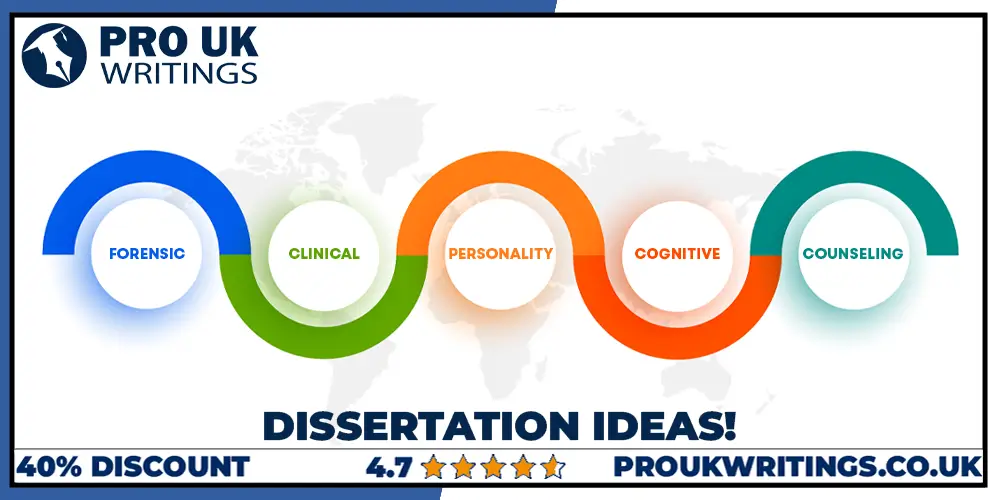
Here is the list of dissertation topics for psychology each mentioned in specific category along with forensic, clinic, personality, cognitive, and counseling psychology dissertation ideas.

Psychological Dissertation for Forensic

  • Importance of psychological profiling in resolving cases.
  • The unstable mentality of a criminal.
  • The testimony of eyewitnesses in jury.
  • The sentence of a mental criminal.
  • Psychological implications in decision making.
  • Psychological facilities for criminals.
  • Childhood traumas responsible for adult criminals.
  • Why society does not consider domestic violence on men considering?
  • Are confessions stated by mentally unstable eye witnesses important or not?

Psychological Dissertation for Clinical

  • Media violence and children.
  • Importance of teletherapy in mental health service.
  • Different methodologies for Post traumatic stress disorder (PTSD).
  • How childhood trauma shapes personality in adulthood.
  • The role of spirituality adding into psychotherapy.
  • Pros and cons of consulting a therapist.
  • Starting stages of Schizophrenia.
  • Obsession with overeating eating disorder.
  • Obsessive compulsive disorder treatment.

Psychological Dissertation for Personality

  • The importance of personality traits in life areas.
  • The importance of good human behavior.
  • How much social media impacts child’s growth in years of adolescence.
  • Impact of environment on human personality.
  • Relationship between well-being and good behavior.
  • The changing phase of human from childhood to adulthood.
  • The crucial importance of good personality in leadership.
  • The role of genetics in shaping a human disposition.
  • The impact of negative impressions on human well-being.

Psychological Dissertation for Cognitive

  • Impact of music on mood and cognitive everyday actions.
  • The sense of right and wrong while making decisions.
  • Stress impact on cognitive performance of a human.
  • The role of remembering something from past in present.
  • Emotional impact on memories.
  • Cognitive growth in children.
  • The multi-tasking ability of human brain.
  • Cognitive response to phobias and anxiety.
  • Cognitive approach of depression shaping the human.

Psychological Dissertation for Counseling

  • Why counseling is important for children?
  • Children speech development.
  • Childhood fears and traumas.
  • Victim of domestic violence.
  • How much racism have impacted peoples well being.
  • The obstacles among students that limits them from living stress-free life.
  • Why people shy away from psychology therapy.
  • How counseling aid disturbed patients from traumatic experiences.
  • How to build a relationship with therapist?

For any type of service and Blog information Pro UK Writings have always exceeded all expectations now that you know all about Psychology Dissertation topics, also make sure to also read Cover Letter, Crtitical Analysis Of Research Paper, &  Language Features.

sebastian james who is a writer at Pro UK Writings

Sebastian James

Blog Author

Meet Mister Sebastian James who is an accomplished academic writer, who holds great credentials in various different faculties of academic writing having the degree of doctorates. Mr. Sebastian James is the original author all of the content written on this website with great knowledge of academics Mr. Sebastian James is the original upfront writer for Pro UK Writings.
FAQs

Find Solutions of your queries 

What is a psychological dissertation?

A psychological dissertation is an original piece of writing that contributes new information to this field of study. A dissertation could be extensive enough to consist of all of the important information, but the writer has to be creative enough to come up with original material with a clinical approach.

What makes a good psychology dissertation?

Invest a good amount of time in research and accumulate all of the relevant data to the topic. Once you have collected the data, make sure to thoroughly research and analyze the data.

How many pages long is a psychology dissertation?

The length of a dissertation depends upon researched data, the topic, the school guidelines, and several other aspects. Each dissertation’s length in comparison to another one is different, but the ideal extensiveness for a psychological dissertation should be anywhere from 180 to 320 pages.

How do you write a title for a dissertation?

The title for your psychological dissertation should be explanatory, specific, and informative, and not general. It should align with your dissertation writing, and the title should include the important components.

How is a psychological dissertation important for learning skills?

Psychological dissertations are more of a clinical and human behavior study approach. Writing dissertations in this field of education helps with creativity, widening knowledge, and critical thinking.

Why is a psychology dissertation important?

Psychology dissertations hold great value in academics. Your grade assessment relies on these; the more precise and of great quality the dissertation you write and submit, the higher the chances of getting better grades.

Categories
Dissertation

Dissertation Sructure

Dissertation Structure:

What is it that brought you here? Well, the most apparent answer to that question seems to be you have been given a dissertation to write but could not figure out the appropriate structure to follow.

You do not have to worry about it anymore because this blog will specifically guide you through all of the steps in details which are essential for a coherent dissertation.

What is a Dissertation?

The best way to incept any project or work is to meticulously study about the topic of subject which allows you to comprehend the concept and permits you to gain more knowledge for the following which eventually leads you to the best end product.

Since here we are discussing about the structure of a dissertation the best way to understand how you can formulate a cohesive piece of work is to initially understand “What is a dissertation?”

Definition for a dissertation is a well-researched highly understandable piece of paper that summarizes student’s point of view for the topic along the lines of academic challenges that one might had to endure on his or her venture. A dissertation is vital for students who want to have tier specified careers through masters and doctoral degrees, dissertation gives an evident peek into student’s research skills, the data analysis and one individual’s dedicated contribution to the project most of the times students get to this question “Who can do my dissertation?” which is why we provide dissertation writing help UK for English dissertation, Finance dissertation, Law dissertation and many more.

Also Read: How, Why, When, and Who Invented Homework?

The Motive Of A Dissertation:

A well formulated dissertation is to give an autochthonous identification to the particular raised question situation dilemma or in general topic an academic dissertation has many different purposes each of which carry vitality in a leaden manner dissertation are a great way for students to demonstrate their expertise and how much they have ace a particular subject in their faculty dissertations enables students put their abilities on the display in regards of academic research, data analyzation, comprehension and inquiry for a particular topic.

Dissertations can also be seen as foundation for the research that is still yet to come galvanizing new investigations and serving reference points for the students occupied in academics furthermore dissertation are crucially important for students who are aiming to have a behold upon the advance degrees because dissertation executes one individuals potential in the field of study exclusively which in addition becomes a leader for students to climb onto for their academic qualifications or to have the career they have been longing for.

To be more specific dissertation play a part in giving meaningful insights expands knowledge and signify competence in scholar field.

Also Read: Gibbs Reflective Cycle: All 6 Stages & Examples | Pro UK Writings

Different Types Of Dissertation:

If you think there is only a single type of dissertation that is an all-purpose you could not be more wrong who can eat one flavor of ice cream for the rest of their life? Nobody, right? Same as that everything if not all than most of the things are out in the world that have their own variations and just like any other dissertations are no different because each student could have a different topic handed over to write a dissertation about.

Here are enlisted the types of different dissertation which you can choose from the one that seems most appropriate format of dissertation writing that aligns with the goal of research and methodology of dissertation:

Empirical Dissertation:

Empirical Dissertation is where one individual gather all of the original research data through experiments analysis surveys and other type of practical engagements. A student here specifically uses primary data to give answers to the research questions.

Theoretical Dissertation:

Theories that already hold a place in history gets studied, examined & observed in this type of dissertation this incepts new theoretical perspectives on the premises of literature retrospection scrutinizing and synthesizing knowledge.

Also Read: Rolfe Reflective Model | What? So What? Now What?

Mixed methods Dissertation:

If you have been given a topic where you have been asked to incorporate both qualitive and quantitative methods of research then mixed method is the perfect dissertation method to use in your project you will be able to stockpile all of the understandable data through reliable resources like surveys, interviews, observations and statistical analysis.

Literature Dissertation:

Literature based dissertations are also commonly known as desk-based or library-based dissertations and in a leaden manner they depended upon chapter of books, academic journals, publication and other piece of paper writings that are published observe the existing literature in order to come up with new theories and frameworks.

Practice Based Dissertation:

Projects that are art based are usually covered in practice-based dissertation technically the type where one person has to be creative with designs, architecture and art.

Case Study Dissertation:

Case study dissertation provides more in-depth study of individuals, groups and phenomena which helps to understand the chosen case more comprehensively, but one thing there is to keep in mind while using this method of dissertation which is that accumulated data should in both quality and quantitative forms.

How To Structure A Dissertation?

Success in field of academics advance degrees could never be reached if the dissertation you are writing are not structured and organized here is a tried, tested and approved structure of how to write a dissertation which will help you in your academic journey read the below the six chapters of dissertation to ace your writing skills and structures.

Also Read: Critical Analysis Of A Research paper 

Illustration of a dissertation structure with six chapters: Introduction, Literature Review, Methodology, Results, Elaboration, and Conclusion.
Following are the six neccessary chapters for dissertation structure:

Chapter 1-Dissertation Introduction:

Introduction is the most fundamental part of dissertation writing because it initially gives an insight of the researches you have conducting in great details try to demonstrate evident purposes and researched questions try to hint at how you are dissertation has been structured so you readers could have an idea of.

Dissertation Introduction Example:

  • What will you be doing investigation about in your dissertation?
  • Why is it worth to be investigated?
  • How you dissertation has been structured?
  • What is the approach to your research?

Also Read: Driscoll Model Of Reflection | What? So What? Now What?

Chapter 2-Literature Review:

Conduct a more in great detail review of the literature make sure to collate crucially observed and synthesize studies and key theories in this step you technically examine the existing research with appropriate perspective to comprehend.

Literature review Example:

  • Does the literature lacks or is organized?
  • How did you develop methodology of your own?
  • Give reasons to how does your research is consisted of originality?
  • Does the bigger picture fits your research or not?

Chapter 3-Methodology:

In this step the methods, design and techniques that all went into the research should be observed give brief interpretation of your choices validation and proclaim them of being appropriate the teacher or professor would want to know if you know what you are doing with your project by examining which methods you have used furthermore you have to explain the reasons behind the research.

Dissertation Methodology Example:

  • What is the research design you had intended here?
  • How are going to justify you research design?
  • Why did you choose to do things this way?
  • How are you going to carry out your research?

Chapter 4-Results:

Give out an evident and exact presentation of your research findings result is the step where data description and presentation is provided be adamant of the fact that your analysis is in support of the main purpose.

Also read: All You Need To Know About Kolb Reflective Cycle

Chapter 5-Elaboration:

Now that we have completed the data analysis and results have been presented it is time to give an explanation and analysis to them to simplify, we mean you would have to discuss what they exactly mean and try to make it sound more in relevancy to your research this is actually crucial step because whatever you will discuss here will directly reflect upon your dissertation methodology.

Chapter 6-Conclusion:

Congratulations on your way down here this is the final step now that results have been discussed and elaborated beginning is calling us again but this time with conclusion to be more specific you must provide an answer to your legit original research questions with conclusion you will be stating your research questions this might sound a bit boing but It’s important because it legitimately is a full circle.

These are the steps which you must follow to structure a well-organized and written dissertation.

Also read: Persuasive Essay Topics you should know!

For any type of service and Blog information Pro UK Writings have always exceeded all expectations now that you know all about Dissertation Structure, also make sure to also read Emotive Language, Language Features and Physiotherapy Dissertation Ideas.

sebastian james who is a writer at Pro UK Writings

Sebastian James

Blog Author

Meet Mister Sebastian James who is an accomplished academic writer, who holds great credentials in various different faculties of academic writing having the degree of doctorates. Mr. Sebastian James is the original author all of the content written on this website with great knowledge of academics Mr. Sebastian James is the original upfront writer for Pro UK Writings.
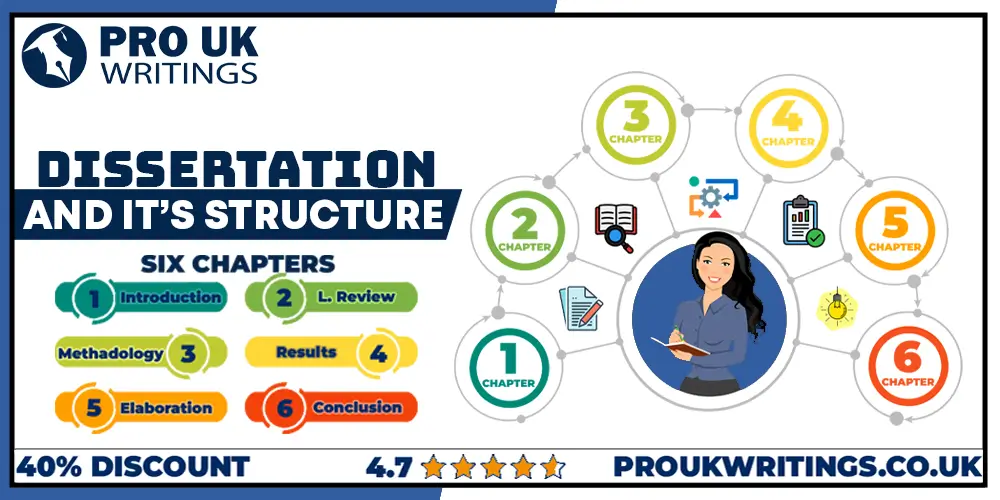
FAQs

Find Solutions of your queries 

What are the 5 chapters of a dissertation?

Below are the 5 chapters of dissertation writing that help craft the structure accurately:

  • Chapter 1: Introduction
  • Chapter 2: Literature review
  • Chapter 3: Methodology
  • Chapter 4: Results
  • Chapter 5: Discussion
What is the biggest part of the dissertation?

The literature review part of the dissertation usually tends to be more extensive than other parts because this area is more detail-oriented and involves giving interpretations of the existing research.

What is the methodology in a dissertation?

The chapter of methodology in a dissertation indicates the research methods that were implemented in the dissertation and any decisions made relevant to the dissertation, along with the challenges faced.

What is the first sentence of the dissertation?

The first sentence of the dissertation is the introduction. Even though this might seem overwhelming, you should always start your dissertation writing with an appropriate introduction.

  •  

Why is structure important in a dissertation?

To formulate any piece of writing, it is essential to follow the appropriate structure because structure greatly increases the quality of the dissertation or any academic paper.

Who can help me with dissertation structure?

At Pro UK Writings, we provide the best dissertation writing help for students. You can place your order for a complete dissertation or ask us to cover specific areas according to your requirements.

Categories
Dissertation

50 Physiotherapy Dissertation Ideas You Must Be Cognizant Of

PHYSIOTHERAPY DISSERTATION:

Writing a dissertation that is neoteric and different from any other of your work or some other students work is a colossal task. And such multiplex subject like Physiotherapy makes it even more stimulating. Lets discuss 50 phsiotherapy dissertation ideas you should know!

Have you ever met a condition where you had to write a dissertation? Or are you here under the particular reason for the circumstance of being asked to write it for the very initial time?

You do not have need to be petrified and anxious for this task because as you will read the inaugural lines on this blog regarding dissertation writing. Dissertation writing will definitely seem more like worth all the effort

Hustling in-between different Physiotherapy dissertation musings or drafting it all by your own potential. All these are on both sides of the road, beneficial and detrimental. Yet, not often but couple of times it can be a bit engulfing to work on an entire exclusive piece of a research paper all by yourself.

In this case, you can confidentially be depended upon this blog for help. It has exclusively been designed to assist you in ascertaining the process of crafting a grade-worthy impactful dissertation.

So, if in status quo you are stuck somewhere in between free avant-garde ideas or being fastidious about choosing dissertation topic here you can read through all of the information below:

CHOOSING A PHYSIOTHERAPY DISSERTATION IDEA:

Students often deal with choosing the right dissertation idea for physiotherapy but mentioned below are some of the best ideas for physiotherapy:

  • TOPIC OF INTEREST

    Always make sure to pick a topic of interest so that you could be engaged with enthrallment as finalizing a dissertation or a project can take months if the picked topic is perforated.

  • RESEARCHING

    Even if you do not formulate it well, you will have to do you researches to some level. It is more acceptable to do it exemplary then, make sure to tread on the heels of correct steps to gather data and note it down in well order.

  • AVOID BASLESSNESS

    A very fundamental part of your academia curriculum if you dissertation it has to be always on spot concise and well-written, your musings should be stowed right in front of the reader dissertations play a major role for student’s academia career as they place great value for grading.

  • PROFESSIONAL GUIDANCE

    Dissertations require a lot of time, creativity and great attention to details the dissertation work can be mentally and physically exhausting for a student therefore, you can ask assistance for such tiring work at Pro UK Writings.

  • DIFFERENT TOPIC

    Make sure your idea is new many students out there commonly go for the topic ideas that other students are going for but it only makes your content banal make sure your dissertation topic is different from prevalent ones.

20 BEST PHYSIOHERAPY DISSERTATION IDEAS

If you want to score your best grades, make sure your ideas for physiotherapy dissertations are exceptional. Below are enlisted 20 best ideas for physiotherapy dissertations:

  • Pediatric Aquatic Therapy: An innovative method Physiotherapeutic Interventions.
  • The Role of Physiotherapy in Addressing Postural Instabilities.
  • Ergonomics in the Workplace: A Physiotherapist’s Perspective.
  • Technological Innovations in Physiotherapy: A Comprehensive Review.
  • Role of Physiotherapy in Improving Cardiovascular Health.
  • Examining the Impact of Exercise Prescription in Mental Health Rehabilitation.
  • Physiotherapy Interventions for Pediatric Developmental Delays.
  • Muscle Imbalances and their Relationship to Injury Prevention.
  • Assessing the Long-Term Effects of Physiotherapy on Quality of Life.
  • Cognitive Rehabilitation in Neurological Disorders: A Physiotherapeutic Perspective.
  • Physiotherapeutic Interventions for Women’s Health Issues.
  • Evaluating the Efficacy of Manual Therapy in Musculoskeletal Disorders.
  • Pediatric Aquatic Therapy: A Novel Approach in Physiotherapeutic Interventions.
  • The Role of Physiotherapy in the Management of Chronic Fatigue Syndrome.
  • The Use of Acupuncture in Physiotherapy Practice.
  • Pediatric Aquatic Therapy: A Novel Approach in Physiotherapeutic Interventions.
  • Exploring Cultural Competence in Physiotherapy Practice.
  • Physiotherapy and Falls Prevention in the Elderly Population.
  • Comparative Analysis of Traditional and Contemporary Physiotherapy Techniques.
  • Comparative Analysis of Traditional and Contemporary Physiotherapy Techniques.

LIST OF FREE DISSERTATION IDEAS FOR PHYSIOTHERAPY

Here you can have insight of most demanding and free ideas for physiotherapy dissertations:

  • Comparative Study of Exercise vs. Manual Therapy in the Treatment of Frozen Shoulder.
  • Investigating the Impact of Aquatic Therapy on Joint Range of Motion in Rheumatoid Arthritis Patients.
  • The Impact of Lifestyle Modification Programs in Physiotherapy for Obesity Management.
  • The Role of Physiotherapy in the Management of Chronic Neck Pain in Office Workers.
  • Assessing the Role of Physiotherapy in Improving Functional Independence in Stroke Survivors.
  • The Impact of Tele-Rehabilitation on Patient Compliance and Outcomes.
  • Evaluating the Efficacy of Kinesiotaping in the Rehabilitation of Sports Injuries.
  • Physiotherapy Approaches for Improving Sleep Quality in Individuals with Chronic Pain.
  • Assessing the Effectiveness of Virtual Reality in Gait Rehabilitation after Lower Limb Amputation.
  • The Impact of Lifestyle Modification Programs in Physiotherapy for Obesity Management.

10 TOPICS FOR PHYSIOTHERAPY DISSERTATION

Below are mentioned the physiotherapy dissertation topics in order to write the best dissertation, you just need to pick topic from below:

  • Comparative Analysis of Different Electrotherapy Modalities.
  • Physiotherapy in the Rehabilitation of ACL Injuries.
  • Impact of Physiotherapy in Improving Quality of Life in Cancer Patients.
  • The Role of Physiotherapy in amplifying Sports Performance.
  • The Use of Biofeedback in Enhancing Rehabilitation Outcomes.
  • Impact of Telehealth in Delivering Physiotherapy Services.
  • Efficacy of Manual Therapy in Treating Musculoskeletal Disorders.
  • The Impact of Mindfulness in Pain Management.
  • Juxtaposition of Different Exercise Programs for Low Back Pain.
  • Physiotherapy in the Management of Whiplash-Associated Disorders.

10 LATEST AND BEST PHYSIOTHERAPY DISSERTATION TOPICS

While it’s challenging to provide an exhaustive list of best physiotherapy topics for dissertations, below are suggested 10 topics that cover different aspects of physiotherapy:

  • Physiotherapy in the Treatment of Chronic Headaches.
  • Cryotherapy and Thermotherapy in Musculoskeletal Rehabilitation.
  • The Role of Physiotherapy in Respiratory Syncytial Virus (RSV) Management in Pediatrics.
  • Postoperative Rehabilitation Following Orthopedic Surgeries.
  • The Role of Physiotherapy in Sports Injury Prevention.
  • Rehabilitation Strategies for Stroke Survivors.
  • Physiotherapy Interventions for Individuals with Ehlers-Danlos Syndrome.
  • Physiotherapy Approaches to Individuals with Chronic Urticaria.
  • Physiotherapy in the Treatment of Individuals with Fibrous Dysplasia.
  • Exercise Prescription for Individuals with Chronic Liver Disease.

ARE YOU IN NEED FOR AN EXPERT DISSERTATION WRITER FOR PHYSIOTHERAPY?

Embarking on a dissertation in the field of physiotherapy underscores the vital need for expertise and guidance from seasoned professionals. A physiotherapy dissertation delves into intricate facets of rehabilitation, musculoskeletal health, and diverse therapeutic interventions, demanding a nuanced comprehension of both theoretical frameworks and practical applications.

Pro UK Writings professional’s expertise ensures that the dissertation aligns with contemporary industry standards, contributing to the enhancement of acknowledgement in the field. Having yourself involved with a seasoned physiotherapy expert does not only enriches the quality of the research but also instills a perception of confidence in the researcher, fostering a scholarly expedition marked by precision and depth.

sebastian james who is a writer at Pro UK Writings

Sebastian James

Blog Author

Meet Mister Sebastian James who is an accomplished academic writer, who holds great credentials in various different faculties of academic writing having the degree of doctorates. Mr. Sebastian James is the original author all of the content written on this website with great knowledge of academics Mr. Sebastian James is the original upfront writer for Pro UK Writings.

FAQs

Find Solutions of your queries 

Which skills are required for a student to learn to become a physiotherapist?

The skills required for becoming a physiotherapist is a set of educational qualifications, practical skills, and personal attributes like:

  • Bachelor’s degree in physiotherapy.
  • Clinical knowledge.
  • Clinical skills.
  • Communication skills.
  • Interpersonal skills.
  • Problem solving abilities.
  • Critical thinking.
  • Physical fitness.
  • Attention to detail.
  • Professionalism.
  • Teamwork.
  • Continuous learning.
Why guidelines are needed for physiotherapy dissertation?

Guidelines provide more clear understanding of what could be expected in dissertation to help students have better insight of objectives and requirements regarding the task. Guidelines serve assured quality measure, once guidelines are provided instructor can give constructive feedback.

Why problem solving is a critical asset in physiotherapy?

Problem solving is crucially significant for physiotherapists as this skill allows an individual to understand the problem in more depth and come up with a solution that aligns with the patient’s preference this clinically allows the physiotherapist to adapt to different dilemmas and come up with best solutions.

How can I study my 1st year of physiotherapy better?

Some tips that can help you study better in 1st year of your physiotherapy is to develop a well-organized study schedule and try to keep up with it, do not just intake the information but try to teach others seek help from different reliable resources regarding the topic.

Can someone write a physiotherapy dissertation for me?

Of course, at Pro UK Writings we have a team of expert physiotherapist writers who are very well educated and disciplined regarding this field if you are currently facing any problem writing physiotherapy dissertation or is not sure if your written work will be accurate then you can avail our service.

How do I choose a topic for my physiotherapy dissertation?

Make sure that your topic is of interest and aligns with your passion try to encounter different topics into consideration and go with the one that speaks to you the most, because when you are comfortable with the topic you picked then it overall results in a very well written dissertation.