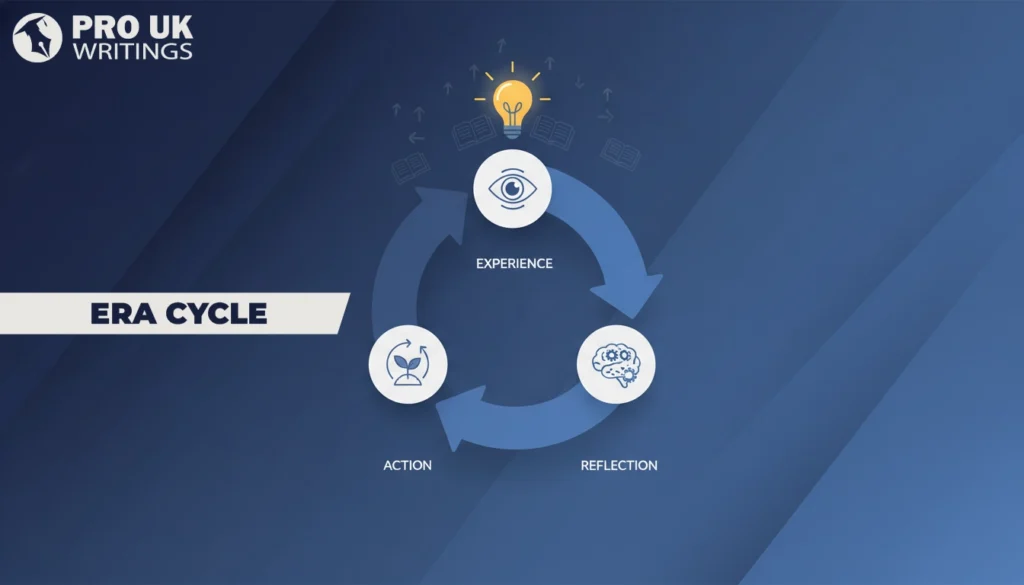
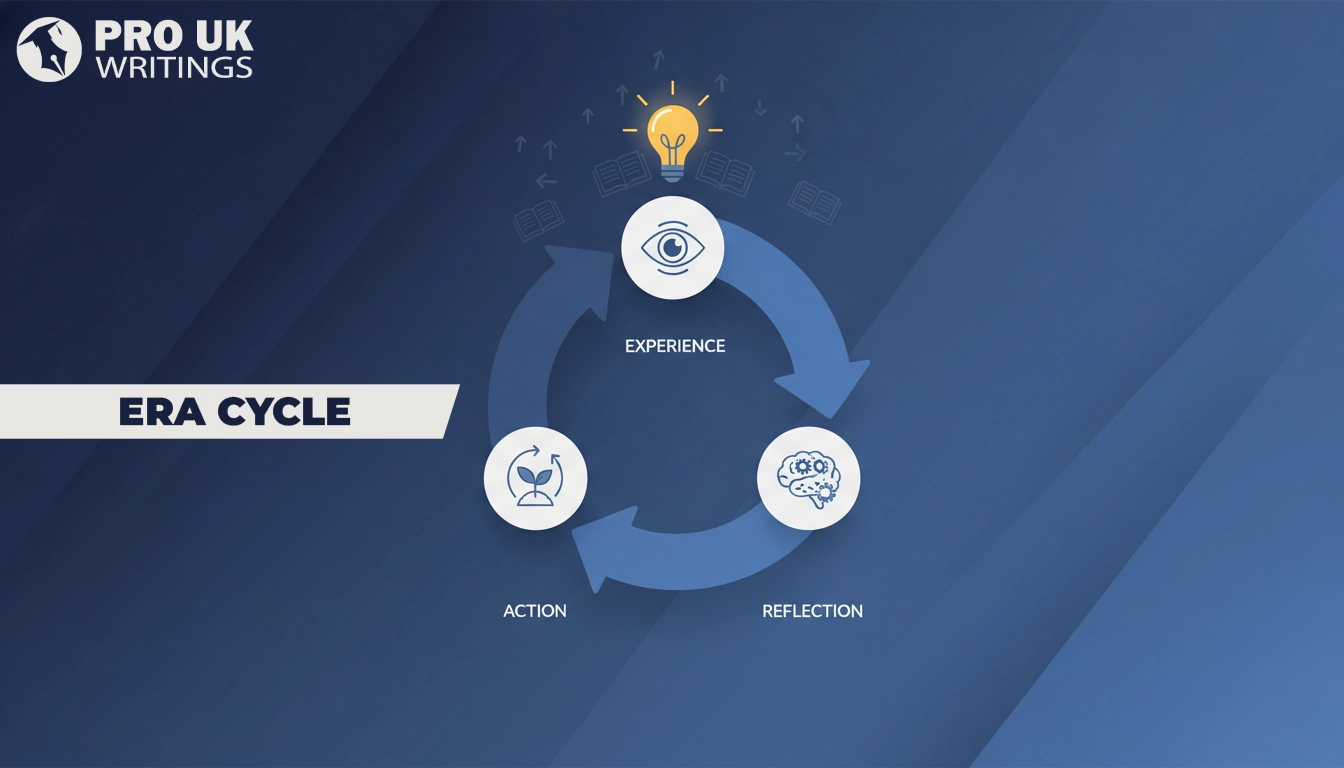
The ERA cycle is one of the most accessible and practical frameworks within modern reflective practice models. Standing for Experience, Reflection, and Action, the ERA reflective cycle provides a structured yet simple approach to learning from real-life situations. Whether used in academic reflection, professional development, or clinical practice, the ERA reflection model helps individuals move beyond describing events and toward meaningful improvement.
Developed by Margaret Jasper in her influential book Beginning Reflective Practice, the Melanie Jasper ERA model was designed to make reflective practice more approachable—especially for beginners. Unlike more complex frameworks that involve multiple analytical layers, the ERA reflective practice framework distils reflection into three clear, logical stages:
- Experience – What happened?
- Reflection – What did you learn?
- Action – How will you improve?
This simplicity is precisely what makes the ERA cycle so powerful.
Need Assisting With any Kind of Writing?
Hire our experienced experts and elevate your grades!
What Is the ERA Cycle?
At its core, the ERA cycle is a structured reflection process that transforms everyday experiences into opportunities for growth. It is based on a natural human learning pattern:- We go through an event.
- We think about what it meant.
- We adjust our future behaviour accordingly.
- Students new to reflective writing
- Nursing and healthcare professionals
- Education and training environments
- Workplace performance reviews
- Placement and internship reflections
The Academic Foundation of the ERA Reflection Model
The ERA reflection model was formally introduced by Margaret Jasper in 2013. In Beginning Reflective Practice, she emphasised that reflection should not feel burdensome or overly academic. Instead, it should function as a practical tool for professional and personal development. Jasper’s approach focuses on clarity and usability. While other reflective practice models can appear dense or theory-heavy, the ERA model provides a clean structure that learners can immediately apply in essays, journals, clinical logs, and case studies. This structured reflection process aligns with core educational principles:- Learning from experience
- Connecting theory to practice
- Encouraging self-awareness
- Supporting continuous professional development
Positioning the ERA Cycle Within Reflective Practice Models
The ERA cycle does not exist in isolation. It sits alongside several well-established reflective learning frameworks. Understanding its position helps clarify its strengths.Comparison with Driscoll’s Model
John Driscoll developed a model based on three questions:- What?
- So what?
- Now what?
| ERA Cycle | Driscoll Model |
| Experience | What? |
| Reflection | So what? |
| Action | Now what? |
Comparison with Kolb’s Experiential Learning Cycle
David A. Kolb introduced a four-stage experiential learning model:- Concrete Experience
- Reflective Observation
- Abstract Conceptualization
- Active Experimentation
- Is more direct
- Requires fewer analytical layers
- Is easier to apply in short academic reflections
- Focuses on immediate improvement
Comparison with Gibbs’ Reflective Cycle
Graham Gibbs developed a six-stage reflective cycle, including:- Description
- Feelings
- Evaluation
- Analysis
- Conclusion
- Action Plan
- Efficiency
- Clarity
- Reduced cognitive overload
- Faster implementation
Why the Jasper ERA model of Reflection Is Beginer-Friendly
One of the primary reasons the ERA cycle is so widely adopted is its simplicity. It breaks down reflective thinking into three logical, memorable stages. This simplicity supports:Clarity
Learners clearly understand what is expected:- First describe.
- Then analyse.
- Finally improve.
Cognitive Accessibility
Unlike multi-layered reflective frameworks, the ERA reflection model mirrors natural thinking patterns. For example:- You attend your first clinical placement (Experience).
- You feel anxious and evaluate your performance (Reflection).
- You decide to improve preparation and confidence (Action).
Cross-Disciplinary Application
The ERA reflective cycle is widely used in:- Education
- Healthcare
- Psychology
- Business
- Social work
- Creative arts
The Role of the ERA Cycle in Reflective Practice
Within the broader landscape of reflective practice models, the ERA cycle functions as:- An introductory framework
- A foundation for deeper models
- A structured reflection process
- A bridge between theory and real-world application
Why the ERA Cycle Remains Relevant
In modern education and professional development, reflective learning is no longer optional—it is essential. Institutions increasingly require students and practitioners to demonstrate:- Self-awareness
- Critical evaluation
- Learning from experience
- Continuous improvement
- Structured clarity
- Academic adaptability
- Professional practicality
- Ease of implementation
The Three Stages of the ERA Reflective Cycle (Detailed Breakdown)
The strength of the ERA cycle lies in its structured simplicity. Unlike other reflective practice models, the ERA reflective cycle breaks reflection into three logical, progressive stages: Experience, Reflection, and Action. Each stage plays a distinct role in transforming events into meaningful learning outcomes. Originally introduced by Margaret Jasper in Beginning Reflective Practice, the ERA reflection model was designed to help learners move from passive experience to active improvement. Let’s examine each stage in complete depth.Stage 1: Experience – “What Happened?”
The first stage of the ERA reflective framework focuses on objective description. This is where you outline the facts of the situation without analysis, emotion-heavy interpretation, or judgment. In many reflective learning models, students make the mistake of blending description and analysis. However, in the ERA cycle, Experience must remain factual and structured.Purpose of the Experience Stage
- Establish context
- Clarify who was involved.
- Outline the sequence of events.
- Present relevant background information.
- Prepare for deeper reflection.
- What happened?
- Where did it occur?
- When did it occur?
- Who was involved?
- What actions were taken?
- What was the outcome?
Key Components of the Experience Stage
To fully optimise reflective writing and avoid superficial description, include:The Specific Situation
Describe the event clearly:- Was it a classroom discussion?
- A clinical placement?
- A workplace conflict?
- A presentation or assessment?
- Nursing consultation in OPD
- Group project disagreement
- Internship evaluation
- Lab experiment outcome
Participants and Roles
Identify:- Your role
- Others involved
- Power dynamics (if relevant)
- Level of responsibility
Context and Background
Explain whether:- The situation was routine or unexpected
- It was your first time handling such a scenario.
- External pressure existed (e.g., time constraints, supervision)
Stage 2: Reflection – “So What?”
This is the analytical core of the ERA reflective cycle. Here, you shift from describing what happened to interpreting why it happened and what it means. Within the broader category of reflective practice models, this stage distinguishes deep reflection from simple storytelling.Purpose of the Reflection Stage
- Analyse your response
- Evaluate strengths and weaknesses.
- Identify emotional reactions
- Link theory to practice
- Extract learning from experience.
- Why did the situation unfold the way it did?
- What went well?
- What did not go well?
- What were you thinking and feeling?
- What influenced your reaction?
- What have you learned?
Core Dimensions of Effective Reflection
Emotional Response
Emotion drives memory and learning. Reflect on:- Anxiety
- Confidence
- Frustration
- Satisfaction
- Doubt
Evaluation of Outcomes
Separate:- Success factors
- Mistakes or missed opportunities
- External constraints
- Personal limitations
Internal Drivers and Bias
Ask yourself:- Did personal values affect your decision?
- Did fear or overconfidence shape your reaction?
- Were you influenced by authority figures?
Theoretical Connections
To achieve high academic quality, connect your experience to theory. For instance:- When reflecting on experiential learning, refer to David A. Kolb and his experiential learning theory.
- If focusing on emotional analysis, compare briefly with Graham Gibbs and his emphasis on feelings.
- If analysing structured questioning, relate to John Driscoll and the “What? So what? Now what?” framework.
- Reflective learning framework integration
- Academic authority
- Depth of analysis
Stage 3: Action – “Now What?”
Without action, reflection remains incomplete. The final stage of the ERA reflection model ensures forward progression. This is where insight transforms into strategy.Purpose of the Action Stage
- Develop a practical improvement plan.
- Identify skill gaps
- Set measurable goals
- Commit to behavioural change.
- Prepare for similar future situations.
- What will you do differently next time?
- How will you implement your learning?
- What skills need development?
- What support systems are required?
- What is your timeline?
Designing a Strong Action Plan
To create a fully optimised action plan in reflective practice, ensure it includes:Specific Behavioural Changes
Instead of vague promises like “I will try harder,” write:- “I will revise consultation procedures weekly.”
- “I will rehearse presentations twice before delivery.”
Skill Development Strategy
Identify:- Communication gaps
- Technical weaknesses
- Time management issues
- Confidence-building needs
SMART Goals
Your plan should be:- Specific
- Measurable
- Achievable
- Relevant
- Time-bound
Continuous Improvement Loop
The ERA cycle is not linear—it is cyclical. Action leads to: New Experience → Reflection → Further Action This reinforces the concept of a continuous reflective process.Why These Three Stages Make the ERA Model Powerful
Compared to more complex frameworks such as:- Kolb’s experiential learning cycle
- Gibbs’ reflective cycle
- Driscoll’s reflective model
- Beginner-friendly structure
- Immediate practical application
- Clarity in academic writing
- Efficient performance evaluation
- Logical cognitive progression
Practical Applications Across Disciplines
The three stages of the ERA reflection model can be applied in:Education
- Assignment reflection
- Placement journals
- Group work evaluation
Healthcare
- OPD consultation reflection
- Clinical error analysis
- Supervisor feedback integration
Business
- Leadership review
- Conflict resolution analysis
- Performance appraisals
Psychology & Social Work
- Client interaction review
- Ethical dilemma evaluation
- Emotional response assessment
Key Takeaways: The Structure of the ERA Reflective Cycle
- Experience → Objective description
- Reflection → Critical analysis and emotional insight
- Action → Strategic improvement plan
In the end we must say, good debates help build a more functional society. They prepare students to be informed, respectful, and sharp thinkers in a noisy world!
FAQs
Find Solutions of your queries
The ERA reflective cycle is used to analyse experiences systematically in academic, professional, and clinical settings. It helps individuals learn from real-life situations by reflecting on experiences and planning improvements for future practice.
The ERA cycle was developed by Margaret (Melanie) Jasper and introduced in her book Beginning Reflective Practice. The model was designed to make reflective practice simple, practical, and accessible, especially for beginners.
Yes, the ERA reflective cycle is widely accepted in universities for reflective essays, placement journals, and learning logs. Its clear structure—Experience, Reflection, and Action—aligns well with academic marking criteria.
The ERA cycle has three stages, while Gibbs’ reflective cycle has six. ERA is more concise and beginner-friendly, focusing on practical improvement, whereas Gibbs’ model allows deeper emotional and evaluative analysis.
Absolutely. The ERA cycle is commonly used in nursing and healthcare to reflect on clinical placements, patient interactions, and professional development. It supports safe practice, learning from errors, and continuous improvement.
The key benefits include simplicity, clarity, improved critical thinking, and actionable learning. The ERA model helps turn reflection into real improvement without overwhelming learners with complex theory.

Blog Author
Meet Mister Sebastian James who is an accomplished academic writer, who holds great credentials in various different faculties of academic writing having the degree of doctorates. Mr. Sebastian James is the original author all of the content written on this website with great knowledge of academics Mr. Sebastian James is the original upfront writer for Pro UK Writings.